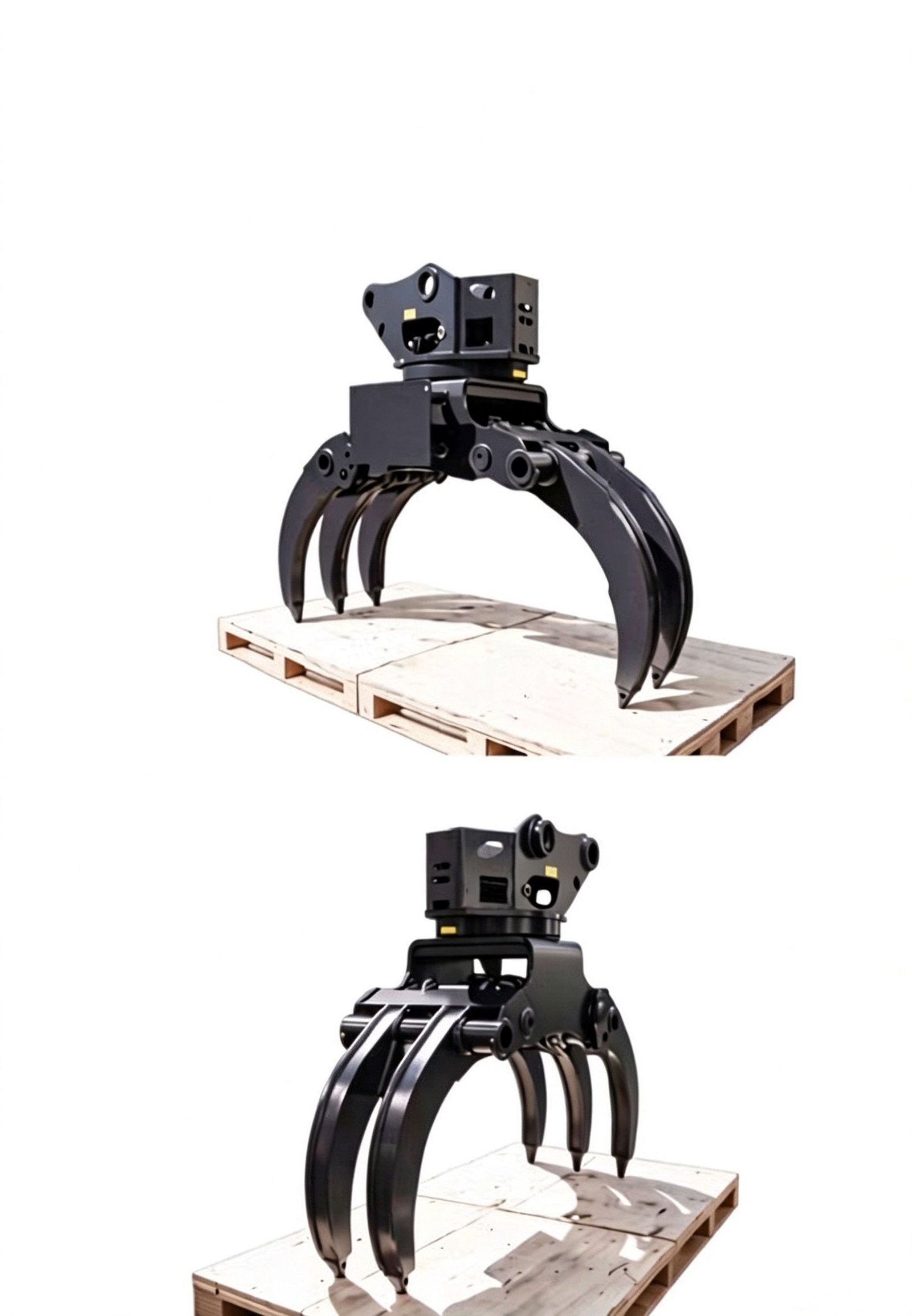
A 6015 body with the tines split two on one side and three on the other, so the jaws close in a staggered pattern instead of meeting face to face.
With a straight tine set, a load that is not a clean cylinder touches the jaws at two points and can roll. Splitting the tines 2+3 makes the closing action staggered: the three tines pass between the two on the opposite side, so irregular timber is gripped at several offsets and sits steadier.
At a glance
| Item | Specification |
|---|---|
| Model | 抓木器 6015 |
| Tine / jaw layout | See drawing for the arrangement on your order |
| Head type | Fixed or rotating – confirmed at order |
| Hydraulic supply | One auxiliary circuit (rotating head) |
| 安装 | Headstock machined to your pin diameter and centre distance |
| Carrier class | Matched to your machine – tonnage and lift chart confirmed before release |
| Finish | Two-pack paint, colour to order |
Dimensions, opening and working load are confirmed against your drawing before production. Nothing on this page is a substitute for that confirmation.
What it is used for
- Irregular and forked timber
- Mixed loads of logs, branches and root balls
- Handling stone and demolition debris
- Site clearance where the load is never uniform
How it is built
- Staggered 2+3 tine arrangement
- 6015 body plate with gussets at the tine roots
- Hardened pins and replaceable bushings
- Cylinder with guarded rod
- Headstock machined to order
What to send with your inquiry
- Excavator make and model, and the lift chart if you have it
- Coupler type – S30, S40, S45, S80 – or the pin diameter and centre distance
- Auxiliary hydraulic flow and pressure (litres per minute and bar)
- What you will handle: log diameter and length, or material type for a clamshell
- Any opening or width the job requires
- Photos of the machine and the coupler help more than a written description
Ordering notes
Each unit is built to the headstock and hydraulic specification confirmed on the drawing. Confirm the drawing before production starts – after the body is cut and the headstock is machined, changes to the pin pattern mean a new headstock, not an adjustment. Spare bushings and pins can be supplied with the unit so the first rebuild does not wait on parts.
Questions we are usually asked
Why split the tines instead of spacing them evenly?
Evenly spaced tines meet in line, so an irregular load is only pinched at the tips. The 2+3 layout closes in a staggered pattern and holds the load at several offsets, which is why it is preferred for mixed timber and debris.
Does 2+3 change the maximum opening?
The mouth is set by the body and tine lengths you order. We confirm both against your drawing.
Can this body take a rotating head?
Yes, with one auxiliary circuit. Fixed head is also available.